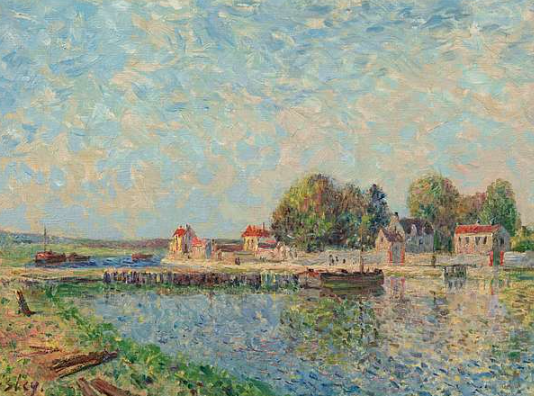
Alfred Sisley may not be the most household name among Impressionists, but his village scenes and tranquil depictions of nature hold a special place in the art world. His ability to capture the essence of rural life and changing landscapes showcases a quieter side of Impressionism that many find profoundly moving. Through his brush, the simple beauty of everyday life is transformed into timeless art.
1. The Essence of Sisley’s Village Scenes
Alfred Sisley’s village scenes are imbued with a sense of peace and nostalgia. His works often feature charming French villages, complete with quaint cottages, flowing rivers, and lush greenery. For instance, “The Bridge at Villeneuve-la-Garenne” paints a serene landscape where gentle waters reflect the soft colors of the sky, inviting viewers into a moment of calm. Such scenes demonstrate Sisley’s eye for detail, as well as his ability to evoke emotion through simplicity.
Moreover, his choice of color and lighting plays a significant role in setting the mood of these village scenes. Sisley often used a soft palette to depict varying times of the day, creating an atmosphere that resonates with tranquility. In works like “The Village of Moret in the Morning,” the warm hues employed highlight the stillness of early mornings, capturing fleeting moments that many might overlook in daily life.
-
- Explore local village scenes in your area for inspiration.
-
- Experiment with soft color palettes in your paintings.
-
- Observe the effects of light at different times of the day.
-
- Try painting en plein air to capture the essence of the moment.
2. The Quietude of Impressionism
What sets Sisley apart in the Impressionist movement is his focus on quietude over drama. Unlike some of his contemporaries, who engaged in bold subjects and dynamic compositions, Sisley portrays peaceful interactions between nature and human life. For example, “Flood at Port-Marly” captures a flood’s aftermath without the chaos; rather, it reflects a serene stillness, allowing the viewer to contemplate the beauty of the scene rather than the calamity it represents.
This emphasis on calm allows viewers to engage in a more meditative experience when viewing his works. It draws the audience in, encouraging personal reflection rather than only visual consumption. Sisley’s paintings often create a safe space where one can escape the noise of modern life, making them particularly relevant today in our fast-paced world.
-
- Find a quiet space in nature to practice mindfulness.
-
- Integrate small moments of stillness into your daily routine.
-
- Observe how different environments evoke similar feelings.
-
- Paint or sketch tranquil scenes to enhance your art practice.
3. Techniques and Styles of Sisley’s Art
Sisley’s technique combines traditional Impressionist brushwork with a unique sensitivity to landscape. He favored a method known as “direct painting,” where he applied paint directly onto the canvas without underdrawing. This allowed him to capture light and movement fluidly, making everyday scenes feel alive and dynamic. His brushstrokes are often short and visible, contributing to the overall movement within the work.
Additionally, Sisley mastered the use of atmospheric perspective, where he skillfully adjusted colors and tones to depict depth. By using lighter, softer colors for distant objects and stronger hues for closer ones, he managed to create captivating vistas. This technique not only enhances the three-dimensional quality of his paintings but also draws the viewer’s eye into the scene, allowing them to feel as if they are physically present in the moment.
-
- Practice short, visible brushstrokes to capture movement in your work.
-
- Experiment with direct painting techniques for immediacy in your art.
-
- Explore atmospheric perspective by creating layers in your compositions.
-
- Attend workshops or classes focusing on Impressionist techniques.
4. Sisley’s Influence on Modern Art
The impact of Alfred Sisley’s quiet Impressionism ripples through contemporary art, influencing artists who seek to capture the everyday beauty of the world. His approach resonates with those who find solace in the subtle and peaceful, encouraging a focus on mindfulness and reflection in art. Modern artists often cite Sisley’s ability to evoke emotion with simplicity as a guiding principle in their practice.
Furthermore, Sisley’s village scenes often inspire urban landscape artists to seek beauty in ordinary settings. Today, creators are increasingly focused on themes of tranquility, encouraging viewers to appreciate stillness amid the chaos of modern life. This legacy confirms that Sisley’s work is not merely a historical reference but a continuing source of inspiration for artists navigating contemporary issues.
-
- Follow contemporary artists who are influenced by Impressionism.
-
- Consider how your work can feature everyday beauty.
-
- Engage with local art communities to share and enhance your practice.
-
- Reflect on the themes of tranquility and mindfulness in your art.
In conclusion, Alfred Sisley’s village scenes and his unique take on Impressionism encourage us to appreciate the serene beauty found in our surroundings. By engaging with his work, we not only enhance our understanding of art but also cultivate a sense of peace and mindfulness in our daily lives. Consider exploring Sisley’s influence in your art or even your lifestyle to find moments of quiet reflection and beauty.