Circles, cubes, triangles, and polygons, seemingly simple mathematical shapes, play a vital role in modern sculpture. Geometric shape sculpture creates three-dimensional works that combine structural beauty and artistic expression through the combination, cutting, and reconstruction of different forms.
From early 20th-century modernist experiments to today’s abstract metal sculptures and low-poly animal forms, geometric art has continuously evolved. Artists not only focus on the shape itself but also express movement, power, and emotion through proportion, volume, and spatial relationships.
1. How Did Geometric Shape Sculpture Develop?
The development of geometric sculpture is closely related to 20th-century modern art movements. Cubism, Constructivism, and later Minimalism all significantly influenced the artistic expression of geometric forms.
Cubism, spearheaded by Pablo Picasso and Georges Braque, attempted to decompose objects into different geometric planes and reorganize the perspective. This creative concept subsequently influenced the development of three-dimensional sculpture.
Russian artists Naum Gabo and Antoine Pevsner further explored the relationship between geometric structures and space. They used lines, planes, and transparent materials to transform sculptures from mere closed entities into open structures that could express space.
In the 1960s, minimalist artists such as Donald Judd began using repetitive cubes, cuboids, and industrial materials, making geometric forms themselves a key element of their works.
2. What are the main types of Geometric Shape Sculpture?
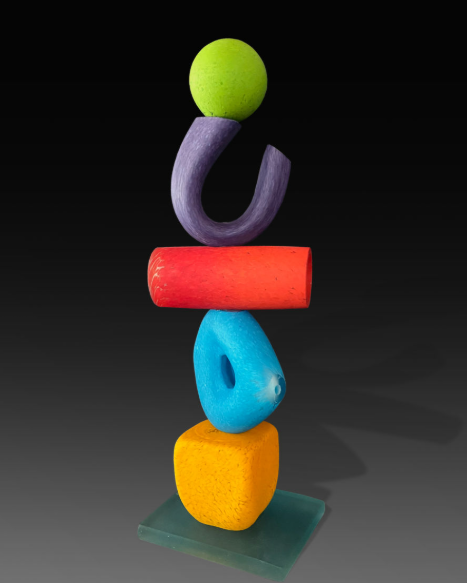
Geometric shape sculpture is not a single art style but encompasses many different forms.
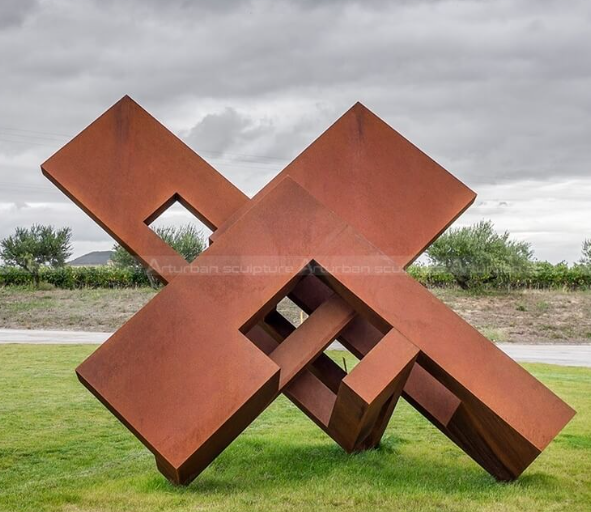
The first type is purely geometric abstract sculpture. These works directly combine basic shapes such as spheres, cubes, and cylinders, emphasizing proportion, repetition, and structural order.
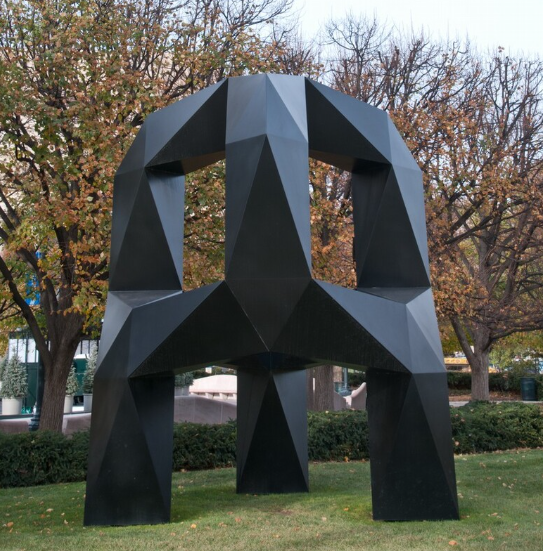
The second type is polyhedral sculpture. Artists use triangles, quadrilaterals, and irregular polygons to construct three-dimensional surfaces, giving the works clear facets and edges.
The third type is geometric figurative sculpture. This form retains the basic outline of a person or animal, but uses geometric planes instead of the muscles, fur, and natural curves of traditional realistic sculpture.
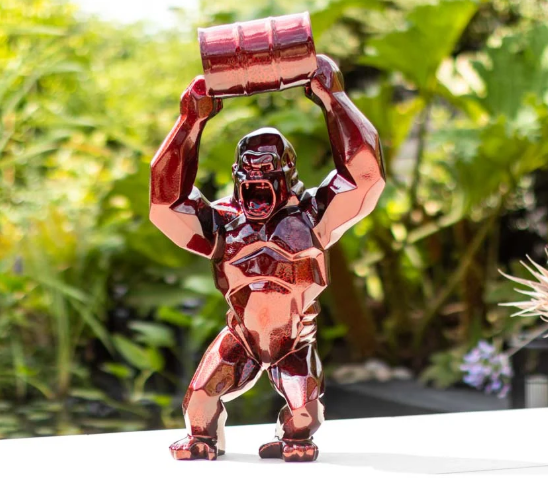
For example, the animal sculptures of French contemporary artist Richard Orlinski often use sharp polygonal facets to represent body structure. In his Wild Kong Oil sculpture, the gorilla’s head, chest, and limbs are treated with angular geometric shapes, while incorporating oil drum elements to link animal power with environmental issues.
3. How do geometric shapes affect the visual expression of a sculpture?
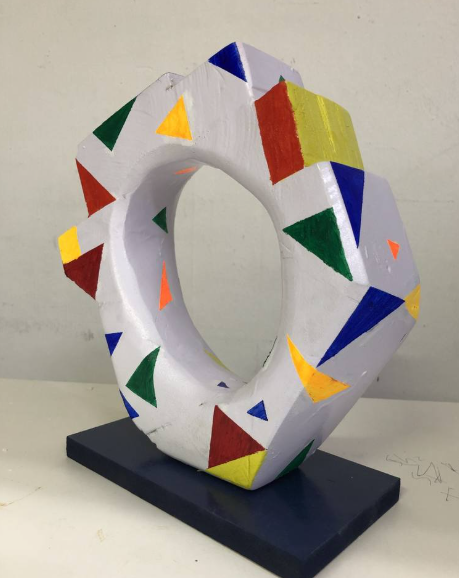
The choice of geometric shapes directly affects the viewer’s perception of the sculpture.
Circles and arcs often create continuous, soft contours, and are therefore frequently used to express flow, balance, and organic forms.
Triangles have a clear directionality. Artists can use sharp angles, sloping structures, and repetition to express speed, tension, or an upward tendency.
Squares and cubes have a strong sense of order and are suitable for constructing stable, regular spatial structures.
In geometric animal sculptures, the size and orientation of different facets are particularly important. Larger planes can encapsulate the main volume of the body, while smaller facets help sculpt the face, joints, and muscle transitions.
Therefore, geometric sculpture is not simply about transforming natural objects into multiple planes, but rather about selectively simplifying forms and reorganizing the viewer’s understanding of volume and structure.
4. Materials and Techniques for Geometric Sculpture
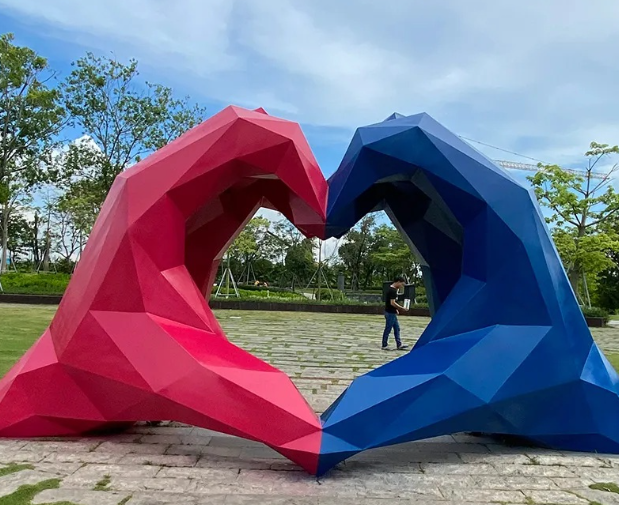
Geometric sculptures can be made using various materials such as bronze, stainless steel, fiberglass, wood, and stone.
Metallic materials are suitable for expressing sharp edges and planar structures. Stainless steel sheets can be cut, bent, and welded into geometric shapes; bronze is often used in casting to create complex polyhedrons and figurative works.
Fiberglass is suitable for creating large or lightweight sculptures with complex surfaces, and can be molded, polished, and painted.
With the development of digital technology, 3D modeling has also become an important tool for geometric sculpture design. Artists can adjust the number of polygons, proportions, and surface structure in modeling software and create prototypes through 3D printing.
However, in actual production, complex geometric shapes still require consideration of structural strength, material thickness, and the connection methods between different components.
5. What impact has geometric sculpture had on contemporary art?
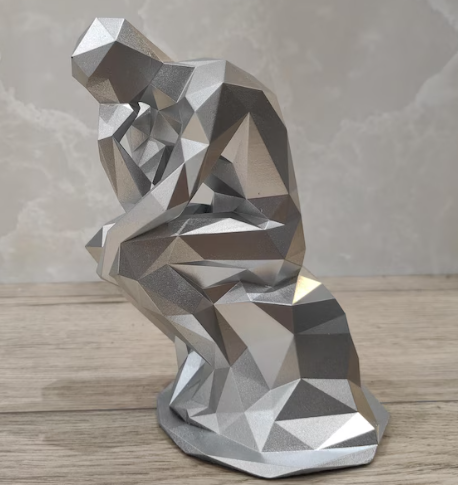
Geometric sculpture has evolved from early modernist formal experimentation into a significant creative approach in contemporary art and design.
In public art, geometric structures can be used to represent large-scale abstract forms; in sculptures of figures and animals, polygonal facets can imbue familiar images with new visual characteristics.
The development of digital art has also made geometric forms more widespread. Low-poly modeling, parametric design, and digital manufacturing technologies allow artists to experiment with complex structures that are difficult to precisely construct using traditional handcrafting methods.
The significance of Geometric Shape Sculpture lies not only in creating a sense of modernity using simple shapes, but also in exploring how to express complex objects, spaces, and ideas through limited geometric elements.
From abstract cubes to polyhedral animal sculptures, geometric art demonstrates the rich possibilities between formal simplification and artistic expression.