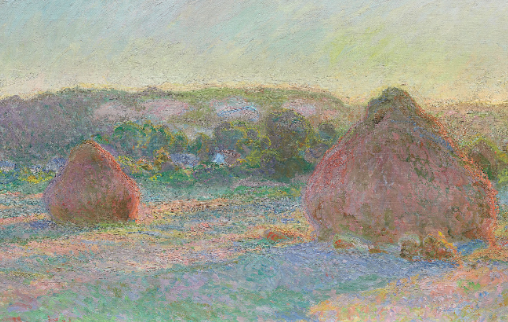
Claude Monet’s haystacks series stands as a remarkable exploration of the interplay between light and colour in nature. Through these enchanting works, Monet invites us to appreciate how light dramatically alters our perception of a familiar scene. Let’s delve into the significance of this series and what it reveals about the artist’s innovative techniques.
1. Understanding Monet’s Haystacks Series
The haystacks series consists of about 25 paintings created between 1890 and 1891, featuring the same subject—haystacks in a field—but depicting them under different lighting conditions. Monet chose this subject because he wanted to focus on the effect of light and atmosphere, showcasing his fascination with nature’s transient beauty. Each painting captures varying times of day and seasons, revealing an ever-changing landscape.
This series is particularly notable for its departure from the traditional methods of representation. Monet’s loose brushwork and vibrant color palettes serve to evoke mood and impression rather than realistic depiction. By concentrating on a singular subject through different lenses of light, he demonstrated that perception is fluid, shaped continuously by environmental conditions.
-
- Explore the series online via virtual museum tours.
-
- Research the different seasons depicted in the paintings.
-
- Examine each painting for variations in color and form.
-
- Consider the emotional responses each piece elicits.
2. Techniques of Light and Expression
Monet’s innovative techniques are fundamental to understanding his artistic vision. He utilized “plein air” painting, working outdoors to capture the natural light and its effect on haystacks in real-time. This method enabled him to study the nuances in colors and shadows that would change minute by minute. The changes in light—from bright daylight to the warm glow of dusk—are what give his haystack paintings their dynamic quality.
The artist also experimented with palette knives and varied brush strokes to layer paint in a way that reflects light and shadow. These techniques create movement within the paintings, allowing viewers to feel as if they are experiencing the moment along with him. The result is a striking visual experience that compels observers to consider how light can reshape their perception of familiar scenes.
-
- Practice painting outdoors to grasp the concept of natural light.
-
- Experiment with different brush strokes to see how they alter texture.
-
- Try using a limited palette to observe light shifts within a color range.
-
- Look for local scenery that changes with the seasons to create your own studies.
3. The Impact of Monet’s Work on Art History
Monet’s haystacks series was revolutionary, paving the way for the Impressionist movement and influencing countless artists thereafter. By concentrating on the effects of light on a single object, he challenged the norms of academic painting, which often focused on detail, perspective, and realistic representation. This resulted in a broader acceptance of subjective impressions and emotional content in art.
Eventually, Monet’s approach influenced expressionists and abstract artists who prioritized personal perspective over realism. The themes of transience and nature can be seen in modern works, bridging a connection between Monet’s exploration and contemporary artistic expressions. Thus, the haystacks not only provide a glimpse into Monet’s genius but also serve as a testament to the shifting currents of art history.
-
- Study other artists influenced by Monet to see his lasting impact.
-
- Visit art galleries showcasing Impressionist works for context.
-
- Read books or articles on the evolution of art movements post-Monet.
-
- Engage with modern art to see how themes from Monet are applied today.
Claude Monet’s haystacks series offers enchanting insights into the relationship between light and perception in art. Each painting serves as a portal into his world, celebrating not just the beauty of haystacks, but also the ephemeral nature of light itself. By understanding this series, we can appreciate the intricate dance of light and color that continues to inspire and influence artists around the globe.
Now that you’ve learned about Monet’s contributions, consider applying his philosophy in your own creative pursuits or simply take a moment to observe how light changes the world around you. Whether you’re an artist or an admirer, there’s always something new to discover in the interplay of light and nature.