
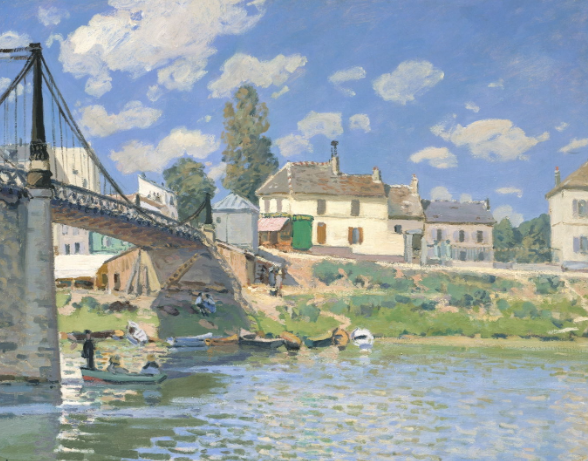
Alfred Sisley, a pivotal figure in the Impressionist movement, has made an indelible mark on the portrayal of English landscapes, particularly through his evocative paintings of the Thames. His ability to capture the play of light and atmosphere across the river and the surrounding countryside invites viewers to immerse themselves in the serene beauty of the English landscape.
1. Sisley’s Artistic Journey in England
Born in France, Alfred Sisley moved to England in 1874. This period marked a significant shift in his artistic style, as he began to explore the picturesque Thames River and its surrounding landscapes. Unlike many of his Impressionist contemporaries who gravitated to bustling urban scenes, Sisley found beauty in the quiet and often overlooked pastoral settings, which he painted with soft brush strokes and luminous colors that evoked a sense of tranquility.
His paintings resonate with a deep appreciation for nature and its transient beauty. For instance, his work “The Thames at Hampton Court” mirrors the gentle ripple of the water and the delicate play of light filtering through the trees. This focus on the harmonious relationship between water, light, and the landscape set Sisley apart and showcased his unique approach to Impressionism.
-
- Explore works by Sisley to understand his style better.
-
- Consider how he contrasts nature with urban settings in his paintings.
-
- Examine the colors and brush strokes he employed in capturing light.
-
- Study the historical context of his time in England.
2. The Influence of the Thames River
The Thames River served not just as a subject but as an inspiration for Sisley. Its winding flow and the varying light conditions throughout the day provided an endless canvas for his creativity. In his iconic piece, “Snow at Eragny,” he portrays the river under the unique subtleties of winter light, creating a dreamy atmosphere that captivates the viewer’s imagination.
In addition to its visual allure, the Thames represented a crucial element of English life during Sisley’s time. The river was central to trade and transport, and Sisley’s paintings often included aspects of daily life along its banks. By integrating boats and figures into his tranquil landscapes, he highlighted the balance between human activity and the natural world, offering a holistic view of the landscape.
-
- Identify how Sisley’s Thames paintings reflect the changing seasons.
-
- Examine the different moods portrayed through water reflections.
-
- Look for human subjects and consider their role in the landscapes.
-
- Research how the Thames influenced other artists during the same period.
3. Techniques and Color Choices in Sisley’s Work
Alfred Sisley’s use of color and technique played a pivotal role in conveying the atmosphere of the English landscape. Utilizing a palette dominated by blues, greens, and earthy tones, his work conveys a harmonic blend with nature. His adept use of light, particularly in capturing the unique effects of sunlight on water, marks his paintings with a sense of immediacy and life. In “The Pool at Moret,” Sisley uses a delicate layering technique to create depth, illustrating his mastery in rendering natural scenes.
Moreover, Sisley’s brushwork—characterized by loose, expressive strokes—invites viewers to experience the transformative quality of light. This technique not only captures the motion of clouds and water but also emphasizes the ever-changing aspects of the landscape. Observing his brushstroke style can provide insights into how emotions can be conveyed through technique in landscape painting.
-
- Analyze the color palettes used in specific paintings.
-
- Draw inspiration from Sisley’s brushwork for your art projects.
-
- Experiment with layering techniques in your own paintings.
-
- Reflect on how light affects color in your observations of nature.
In conclusion, Alfred Sisley’s Thames paintings and English landscapes encapsulate a world of tranquility and beauty that continues to inspire audiences today. By understanding his techniques and the inspirations behind his work, one can gain a deeper appreciation for both the artist and the breathtaking landscapes he portrayed. If you’re inspired by Sisley’s work, consider exploring the landscapes around you or even trying your hand at painting them for yourself.