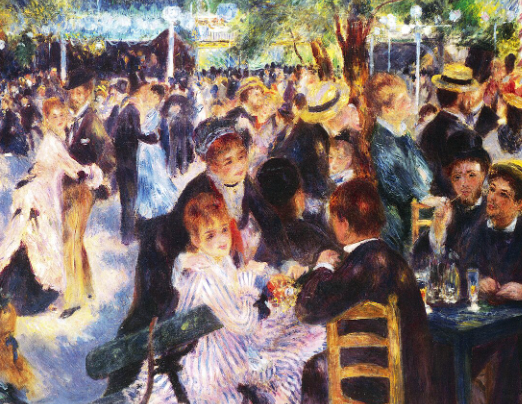
Pierre-Auguste Renoir’s “Bal du moulin de la Galette” is a hallmark of Impressionist artistry. This vibrant painting captures a lively Sunday afternoon in Montmartre, portraying the joy and spontaneity of Parisian social life in the late 19th century.
1. The Setting and Context
The scene depicted in “Bal du moulin de la Galette” takes place at a popular outdoor dance hall in Montmartre, Paris, frequented by Parisian society and artists. During the late 1800s, Montmartre was a gathering place for the avant-garde, offering a glimpse into the vibrant culture of post-Haussmannian Paris. Renoir’s choice to represent this locale emphasizes the work’s significance as a documentation of both historical and cultural dynamics of everyday life.
During this era, social changes allowed for increased leisure activities among the working and middle classes. Renoir’s depiction of this milieu captures both the liveliness and camaraderie present at these gatherings, which draw in people from various backgrounds. This blending of classes can be seen in the clothing styles and the diverse group of figures within the painting, which shows the melting pot that Montmartre became.
-
- Research the historical context of Montmartre during the late 19th century.
-
- Visit places in Paris to better understand the city’s artistic heritage.
-
- Read about the social changes in France during this time.
-
- Explore the significance of outdoor leisure spaces in French culture.
2. Composition and Color
Renoir’s composition of “Bal du moulin de la Galette” is notably dynamic, capturing the movement of the crowd while also isolating individual figures. The circular arrangements of people mirror the motion of dance, drawing the viewer into the scene. Through the use of light and shadow, Renoir demonstrates a masterful understanding of outdoor illumination, providing depth and vitality to the figures and surroundings.
The vibrancy of Renoir’s color palette—rich hues of blues, reds, and greens—evokes a sense of warmth and motion. The interplay of light through the leaves creates a dappled effect on the dancers’ faces and clothing, emphasizing the joyous ambiance of the celebration. This particular technique reinforces the Impressionist ethos of capturing a fleeting moment in time rather than adhering to sharp outlines and rigid figures.
-
- Analyze the color scheme of the painting and its emotional impact.
-
- Examine the positioning of figures for insights on social dynamics.
-
- Identify techniques Renoir uses for rendering light and shadow.
-
- Consider how movement and composition contribute to storytelling in art.
3. Themes of Joy and Community
“Bal du moulin de la Galette” encapsulates themes of joy and community, reflecting the social interaction prevalent in 19th-century Paris. The painting showcases a collective experience where individuals participate equally in joyous celebrations, creating a sense of harmony and togetherness. This aspect is particularly notable as it reflects the burgeoning urban culture, where public spaces became essential sites for social engagement.
Moreover, the emotions conveyed through the figures’ expressions and gestures resonate with viewers, drawing them into the collective experience. From laughter to dance, each character embodies the spirit of leisure and camaraderie, pushing back against the hardships of everyday life. Renoir himself was deeply influenced by the enjoyment of life, as seen in his paintings that often evoke warmth and happiness, offering a welcome respite from the more serious themes explored by other artists of his time.
-
- Reflect on personal experiences of community gatherings.
-
- Engage with local social activities to understand the importance of community.
-
- Discuss artwork that best showcases joy and leisure.
-
- Consider how public spaces in your area facilitate social interaction.
4. Renoir’s Artistic Techniques
Renoir’s techniques in “Bal du moulin de la Galette” exemplify the characteristics of Impressionism. His use of brush strokes, often described as broken or dappled, creates texture and spontaneity in the painting. These short, quick strokes were revolutionary, as they diverged from the traditional methods of blending and smoothing that dominated the art world prior to Impressionism.
Moreover, Renoir’s innovative use of color theory—harmonizing warm and cool colors—allows for a vibrant portrayal of light, producing shadows that enhance the three-dimensionality of his subjects. His approach invites the viewer not just to observe but to feel the atmosphere of the scene rather than simply interpret what is seen. This technique introduces an emotionality that resonates deeply, drawing one back into the scene over and over again.
-
- Try replicating Renoir’s brushstroke techniques at home.
-
- Experiment with color mixing to understand the effects of light.
-
- Study other Impressionists to compare techniques.
-
- Visit art classes to learn about modern applications of Impressionist techniques.
In conclusion, “Bal du moulin de la Galette” stands as a commendable piece in the tapestry of Impressionist art, marvelously encapsulating joy, community, and the hustle and bustle of Parisian life. Delving into the intricacies of this masterpiece opens opportunities for exploration and understanding of both art and societal movements. Consider visiting galleries to observe such works firsthand, or start your artistic journey by experimenting with your own interpretations of joy and community in art.