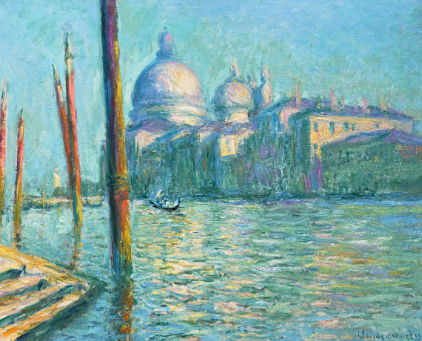
Claude Monet, a prominent figure in the late Impressionist movement, found inspiration in the enchanting city of Venice, capturing its ethereal beauty through a unique lens. His Venice paintings encapsulate the sublime interplay of light and water, showcasing Monet’s masterful technique and his profound emotional connection to the landscapes.
1. The Inspiration Behind Monet’s Venice Series
Monet’s fascination with Venice began during his visit in 1908, a critical period in his artistic career characterized by an exploration of color and light. This encounter was transformative, as he was drawn to the city’s shimmering canals and the mesmerizing reflections they created. The optical phenomena present in Venice allowed Monet to experiment with his brushwork and palette, leading to some of his most renowned works.
In his Venice paintings, such as “The Grand Canal” and “Saint-Lazare Station,” he focused on the atmospheric effects of sunlight filtering through the water. The fleeting moments he captured embody the essence of Impressionism, breaking away from traditional modes of representation. This fresh perspective illustrates his commitment to portraying a scene as it is experienced in real-time, rather than how it looks in a static photograph.
-
- Explore the geographical features and light conditions of Venice before creating your art.
-
- Experiment with different brush techniques to capture the fluidity of water.
-
- Consider the time of day for a different emotional effect—morning light versus twilight.
-
- Study Monet’s color palette to integrate similar hues into your own work.
2. Techniques Employed in Monet’s Venice Paintings
Monet employed a variety of innovative techniques while painting in Venice, emphasizing spontaneity and emotion. One of his hallmark methods was applying paint with quick, loose brush strokes which allowed for the blending of colors directly on the canvas. This technique made it possible for him to capture the transient quality of light and the reflections in the water, which were constantly changing.
Moreover, Monet’s use of color was revolutionary during this period. He often employed a bright and varied palette, dabbling in hues that invoked a sense of immediacy and movement. Instead of mixing pigments on a palette, he laid them directly onto the canvas, thus creating a visual energy that breathes life into the viewer’s experience. This approach exemplifies the late Impressionist era, where emotions took precedence over detail.
-
- Practice applying paint directly to the canvas without mixing for more vibrant colors.
-
- Use a combination of short and long brush strokes to create texture and depth.
-
- Focus on light changes at different times of the day to enhance emotional depth.
-
- Consider the mood you want to evoke and choose your colors accordingly.
3. The Legacy of Monet’s Venice Paintings
The significance of Monet’s Venice paintings extends beyond their aesthetic beauty. They played a crucial role in redefining Impressionism, steering it toward a more abstract and expressive future. By focusing on ephemeral effects rather than hard forms, Monet paved the way for future movements, influencing artists like Van Gogh and abstract expressionists in the 20th century.
Many of these paintings are now housed in prestigious museums worldwide, showcasing their enduring relevance. Exhibitions focused on Monet’s Venice works continue to attract art enthusiasts, confirming his status as a master of light and color. The emotional connection and unique interpretation of landscapes resonate with contemporary audiences, proving that art can transcend time.
-
- Visit art museums or exhibitions featuring Monet’s work for firsthand experience.
-
- Read literature on Impressionism to understand its evolution and impact.
-
- Explore workshops or courses that emphasize Impressionist techniques.
-
- Engage with local art communities to exchange ideas and experiences related to Impressionism.
In conclusion, Claude Monet’s Venice paintings are not merely artistic endeavors but transformative experiences that alter the way we see and appreciate our surroundings. As you delve deeper into the world of Impressionism, consider experimenting with light and color in your own artistic journey, inspired by Monet’s extraordinary works.