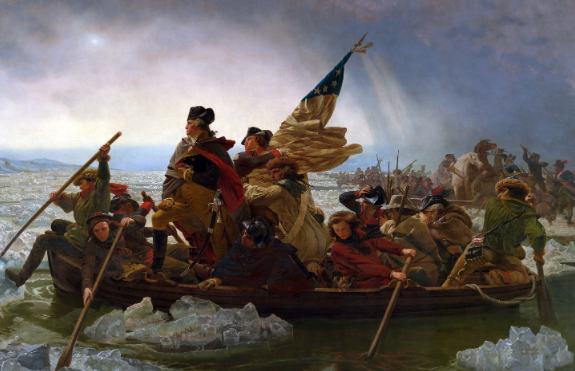
“Washington Crossing the Delaware” is a highly recognizable work in American historical painting. In the center of the painting, George Washington stands on a boat, while soldiers struggle across the icy river behind him. It depicts the historical event of the Continental Army crossing the Delaware River on December 25-26, 1776, in preparation for a raid on Trenton, New Jersey. However, this painting is not a record of the event itself, but rather a reconstruction of the historical scene by the artist approximately 75 years later.
How Emanuel Leutze Reimagined the Crossing
This work, completed in 1851 by the German-American painter Emanuel Leutze, is now in the collection of the Metropolitan Museum of Art in New York. Painted on canvas, it measures approximately 3.79 meters high and 6.48 meters wide, possessing a visual scale approaching that of a mural. Leutze primarily completed this work in Düsseldorf, Germany, rather than sketching on the banks of the Delaware River in the United States.
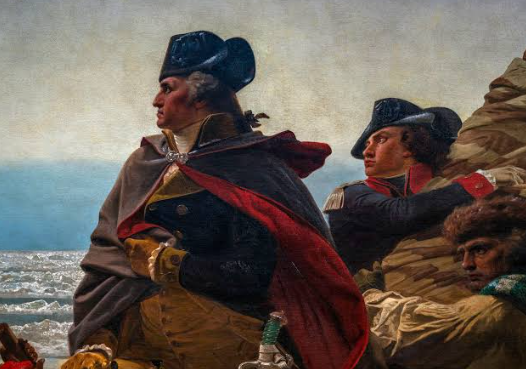
The painting employs a distinct diagonal composition. The boats extend from the lower right to the upper left, with Washington standing near the visual center. Soldiers, oars, flags, and ice blocks create a continuous direction of movement, naturally drawing the eye to the standing Washington.
This treatment gives the figure an almost monumental effect. Similar to many later George Washington Sculptures that emphasize posture, uniforms, and silhouettes, Leutze did not treat Washington as an ordinary soldier, but rather highlighted him from the crowded scene through position, posture, and proportion.
Light and Figure Arrangement Create Drama
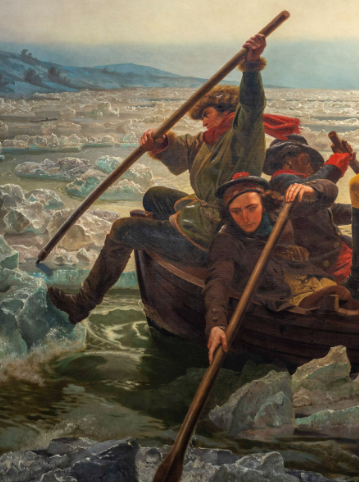
One of the most striking artistic features of this painting is its strong sense of drama. The sky gradually transitions from dark clouds to bright areas in the distance, with Washington and the flag behind him positioned in the brighter areas. The other figures on the boat are in various poses: some are paddling, some are maintaining their balance, and some are close to the side of the boat, reinforcing the tension of the cold weather and the crossing.
Leutze also deliberately arranged figures in different clothing and poses, giving the group on the boat a rich visual depth. What viewers see is not simply a single boat, but a meticulously organized group portrait of history.
Why is the painting not entirely consistent with historical fact?
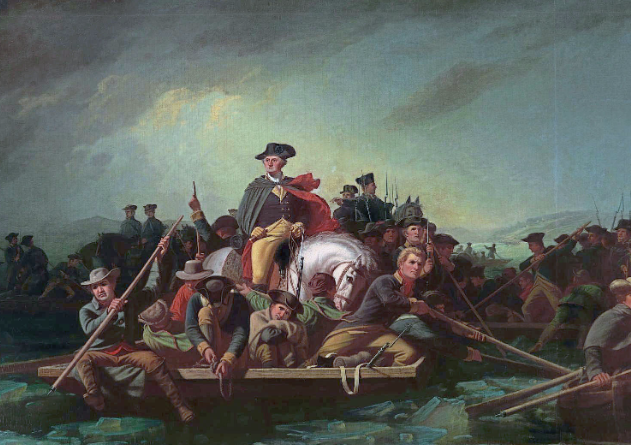
While Washington Crossing the Delaware is based on a true event, many details are inaccurate.
The boat in the painting is noticeably smaller. Historical records show that the Continental Army primarily used larger Durham boats, typically 40 to 60 feet long. The Stars and Stripes appearing in the painting is also a design that was only officially adopted later; it was not yet the American flag when the crossing took place in December 1776.
Furthermore, the actual crossing occurred primarily at night and in inclement weather. A complete depiction of the actual environment would likely result in a very dark painting, making it difficult to clearly show so many figures. Leutze clearly chose artistic visibility and dramatic effect over a rigorous on-site reconstruction.
From Historical Painting to Classic Visual Symbol
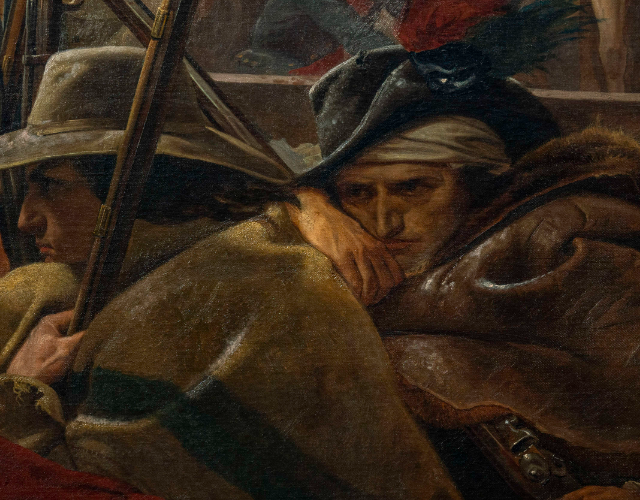
Leutze actually created two main versions. The first version was damaged in a fire in 1850, restored, and kept in Bremen, Germany, before being destroyed in a bombing during World War II. The version most familiar to us today is the second one from 1851, which later entered the collection of the Metropolitan Museum of Art.
This work has since spread through prints, publications, and various reproductions, gradually transcending the realm of a typical historical painting. The Metropolitan Museum of Art considers it one of the most famous and widely disseminated images in American art.