Édouard Manet is often hailed as a pivotal figure in the transition from Realism to Impressionism. His groundbreaking techniques and distinctive subject matter not only challenged the conventions of his time but also laid the groundwork for future artistic movements. In this blog post, we will explore the intricate connection between Manet, Realism, and Impressionism.
1. Manet’s Role in the Realist Movement
Manet’s early works reflect the principles of Realism, a movement emphasizing the depiction of ordinary life. His painting “Olympia” (1863) showcases a nude woman gazing defiantly at the viewer, which starkly contrasts with the idealized representations common in academic art. Here, Manet presents a modern-day subject with an unembellished realism that captures both the beauty and rawness of life, inviting viewers to confront the realities of the human experience.
In addition to challenging traditional aesthetics, Manet’s use of light and shadow contributes to the feeling of immediacy and presence. His portrayal of urban life, particularly in works such as “The Luncheon on the Grass” (1863), further anchors him in the Realist movement. In this painting, the casual setting and the inclusion of contemporary clothing engage viewers in a narrative that speaks to the social dynamics of the time.
-
- Explore Manet’s early works to understand his Realist techniques.
-
- Observe how he incorporates everyday scenes into his art.
-
- Consider the social commentary embedded in his work.
-
- Examine his daring portrayals of the human figure.
2. Transition to Impressionism
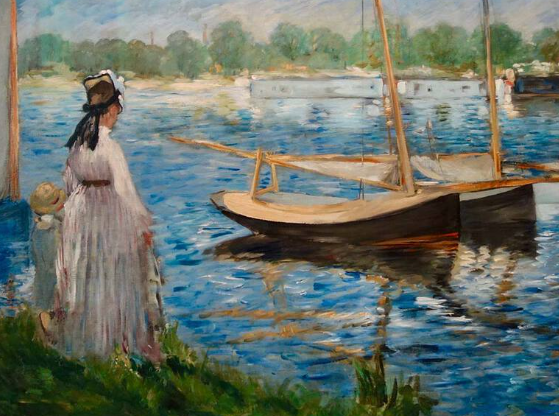
While firmly rooted in Realism, Manet’s approach began to shift, leading him toward Impressionism. He started to experiment with looser brushwork and lighter palettes, which aimed to capture the fleeting effects of light. Instead of meticulously detailing every aspect of a scene, he preferred to suggest forms and movements, as seen in his later work “Impression, Sunrise” (1872), which subsequently gave the Impressionist movement its name.
Moreover, Manet’s involvement with the Impressionist group in the 1870s allowed him to influence and be influenced by fellow artists such as Claude Monet and Pierre-Auguste Renoir. His emphasis on modern life and the integration of vibrant colors prompted a reconsideration of composition and subject matter in art. As such, artists began to appreciate spontaneity, emphasizing the perception of a moment rather than a meticulously rendered reality.
-
- Study how Manet’s brushwork evolved over time.
-
- Understand the importance of natural light in his works.
-
- Explore how he engaged with contemporary Impressionists.
-
- Examine the themes of modern life in his later work.
3. The Legacy of Manet’s Fusion of Styles
Manet’s innovative approach provided a bridge between Realism and Impressionism, shaping the trajectory of modern art. The techniques he developed not only influenced his contemporaries but also paved the way for future artists to explore abstraction and expression. His bold compositions inspired movements beyond Impressionism, serving as a stepping stone toward contemporary art.
In addition to his stylistic contributions, Manet’s focus on societal themes and the human condition resonates in modern art. His willingness to confront difficult subjects sparked discussions about art’s role in reflecting societal norms. As such, the legacy of Manet remains vital for understanding the evolution of Western art and the ongoing dialogue about realism and representation.
-
- Reflect on how Manet’s works influence modern artists.
-
- Consider the societal themes present in his art.
-
- Explore how Manet’s style can inform contemporary art practices.
-
- Engage with art communities to discuss Manet’s impact.
As we examine Édouard Manet’s contributions to the art world, we recognize his essential role in blending Realism and Impressionism. This exploration not only enriches our understanding of historical art movements but also invites us to appreciate the evolution of artistic expression. Take the time to explore Manet’s work further, consult art history resources, or even visit a gallery where his pieces are displayed, to gain deeper insights into his transformative artistry.