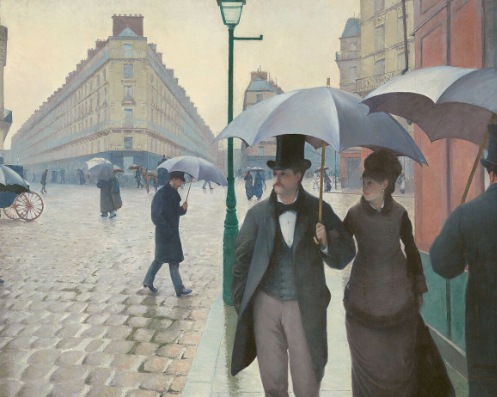
Gustave Caillebotte’s “Paris Street; Rainy Day” is a captivating piece that provides a glimpse into late 19th-century Paris. This painting not only captures a moment in time but also reflects the social dynamics and architectural advancements of the period. In this blog post, we will analyze the various elements of this artwork and understand its significance in both art history and society.
1. Artistic Techniques and Composition
Caillebotte employs masterful techniques in “Paris Street; Rainy Day,” using perspective and light to engage viewers. The painting features a unique vantage point, showcasing a bustling street scene from a low angle that gives a sense of depth. This perspective invites viewers to feel as if they are part of the lively Parisian environment, engrossed in the daily hustle and bustle.
Moreover, the use of light and shadow highlights the rainy conditions, with reflections on the wet pavement accentuating the figures and buildings. The meticulous attention to detail, from the umbrellas to the wet cobblestones, underscores Caillebotte’s ability to capture realism. This level of detail was not typical for Impressionist painters of his time, making his work stand out significantly.
-
- Observe how light interacts with objects in the painting.
-
- Notice the perspective—how does it draw you in?
-
- Examine the use of shadows and reflections on wet surfaces.
-
- Consider the placement of figures and their relation to the environment.
-
- Identify any contrasting elements between the people and surroundings.
2. Social Commentary and Urban Life
<p”Bustling cities like Paris during the late 1800s were undergoing significant transformations, and Caillebotte’s painting reflects these changes. The artwork presents a diverse mix of social classes, as individuals in stylish attire walk alongside commoners, illustrating the shift in urban dynamics. Through the inclusion of both wealthy and working-class figures, Caillebotte comments on the societal changes brought about by modernization and industrialization.
The painting serves as a visual record of Parisian life, capturing a moment where the traditional and modern worlds collide. The architecture, featuring Haussmann’s new boulevards and apartments, indicates a city embracing progress and change. These elements make “Paris Street; Rainy Day” not just a beautiful artwork but also a historical document that sheds light on the socio-economic landscape of the time.
-
- Research the historical context of Paris in the late 19th century.
-
- Analyze how the figures’ attire reflects their social status.
-
- Think about how urbanization has reshaped modern cities.
-
- Explore the contrasting elements within the society depicted.
-
- Consider what Caillebotte might be saying about the future of cities.
3. The Influence of Caillebotte and His Legacy
Caillebotte was not only an artist but also a significant figure in the Impressionist movement, influencing his contemporaries profoundly. His dedication to realism and meticulous attention to detail provided an alternative approach to the often loose brushwork of his peers. Caillebotte’s passion for everyday life and urban settings laid the groundwork for future generations of artists, who would explore similar themes in novel ways.
The artist also played a role in promoting the Impressionist movement by organizing exhibitions and collecting works from fellow artists. His support helped bring greater recognition to the movement. “Paris Street; Rainy Day” is undoubtedly one of his most famous pieces and continues to inspire discussions about the evolution of art, techniques, and societal representation.
-
- Explore Caillebotte’s other works for broader insights.
-
- Investigate how his techniques influenced later artists.
-
- Understand the role of art collectors in supporting movements.
-
- Look into how Caillebotte’s life experiences shaped his art.
-
- Participate in local art discussions focusing on the Impressionist movement.
In conclusion, Gustave Caillebotte’s “Paris Street; Rainy Day” remains a vivid testament to the enchanting complexities of late 19th-century Paris. Through its detailed portrayal of urban life and sociocultural dynamics, the painting opens a window to the past. Readers interested in history or art should delve deeper into Caillebotte’s work to appreciate the intricate relationship between art and society.