Pop Art emerged in the 1950s and became one of the most recognizable art movements of the twentieth century. Instead of focusing only on traditional fine-art subjects, Pop artists turned toward advertising, comic books, consumer products, celebrities, packaging, and mass media.
The movement developed most strongly in Britain and the United States, although its influence quickly spread internationally. Many Famous Pop Art Artists transformed ordinary objects and familiar images into paintings, prints, sculptures, and installations that questioned the boundaries between popular culture and fine art.
Andy Warhol
Andy Warhol is arguably the most famous figure associated with Pop Art.
Born in Pittsburgh in 1928, Warhol began his career as a commercial illustrator before becoming a central figure in the New York art scene.
His work frequently used images taken from advertising, consumer packaging, newspapers, and celebrity photography.
Among his best-known works are:
- Campbell’s Soup Cans
- Marilyn Diptych
- Brillo Boxes
- Eight Elvises
Warhol frequently used silkscreen printing, allowing him to repeat images with slight variations.
Repetition became an important part of his visual language. A soup can, movie star, or product package could be reproduced again and again, reflecting the mass production and media saturation of modern consumer culture.
Roy Lichtenstein
Roy Lichtenstein developed one of the most instantly recognizable styles in Pop Art.
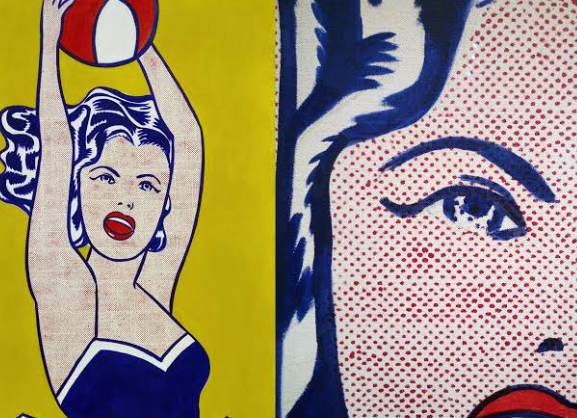
His paintings often borrowed the visual language of comic books, using bold outlines, flat areas of color, speech balloons, and Ben-Day dots.
Famous works include:
- Whaam!
- Drowning Girl
- Look Mickey
- Hopeless
Rather than simply enlarging comic images, Lichtenstein carefully reconstructed them as paintings.
By taking imagery associated with inexpensive popular entertainment and presenting it in galleries, he challenged traditional distinctions between commercial illustration and fine art.
His work remains closely associated with the graphic appearance of 1960s American Pop Art.
Claes Oldenburg
Claes Oldenburg brought Pop Art into three-dimensional form.
He became famous for transforming ordinary consumer objects into oversized sculptures.
Food, household items, tools, and everyday objects appeared repeatedly in his work.
Some of his best-known subjects include:
- Hamburgers
- Ice cream cones
- Typewriters
- Clothespins
- Spoons
- Lipsticks
Oldenburg often changed the scale or material of familiar objects, making them appear strange despite being instantly recognizable.
Later, working with Coosje van Bruggen, he created monumental public sculptures installed in cities around the world.
These large-scale works helped expand Pop Art beyond galleries and into public spaces.
James Rosenquist
James Rosenquist brought the visual language of billboards into painting.
Before becoming widely known as an artist, he worked as a billboard painter in New York. This experience strongly influenced his use of enormous scale and fragmented commercial imagery.
His most famous work, F-111, combines images of military technology, consumer products, food, and advertising-style imagery across a massive composition.
Rosenquist often placed unrelated images next to one another.
The result reflected the experience of seeing advertisements, television, products, and news imagery competing for attention in modern life.
Tom Wesselmann
Tom Wesselmann is another major figure in American Pop Art.
He is particularly known for his Great American Nude series, as well as still-life compositions featuring household products, food, interiors, and advertising imagery.
Wesselmann often combined flat areas of strong color with recognizable consumer objects.
His still lifes could include items such as:
- Cigarettes
- Radios
- Food packaging
- Bottles
- Kitchen appliances
By combining traditional artistic subjects such as the nude and still life with imagery from advertising and consumer culture, Wesselmann created a distinctive version of Pop Art.
Robert Indiana
Robert Indiana became famous for combining words, numbers, and bold geometric shapes.
His best-known image is LOVE, which features the letters L and O above V and E, with the O tilted to one side.
The design appeared in paintings, prints, stamps, and monumental sculptures.
Large versions of LOVE have been installed in cities and museums around the world.
Indiana’s work demonstrates how Pop Art could use simple language as a powerful visual symbol.
Rather than focusing primarily on celebrity or commercial packaging, he often explored words connected with American identity, politics, emotion, and everyday life.
Richard Hamilton
Richard Hamilton was one of the most important early British Pop artists.
His 1956 collage Just what is it that makes today’s homes so different, so appealing? is often discussed as an important early work in the history of Pop Art.
The collage combines images of consumer products, advertisements, domestic interiors, popular entertainment, and idealized bodies.
Hamilton was interested in the rapidly changing visual culture of the postwar period.
His work helped establish many themes that later became central to Pop Art, including consumerism, advertising, technology, celebrity, and mass-produced imagery.
Eduardo Paolozzi
Eduardo Paolozzi was another important figure in the development of British Pop Art.
Even before Pop Art became an established movement, Paolozzi was creating collages using images taken from American magazines, advertisements, science fiction, and consumer culture.
His 1947 collage I Was a Rich Man’s Plaything is often cited as an early example of imagery that anticipated Pop Art.
Paolozzi later worked extensively in sculpture and printmaking.
His interest in machinery, technology, popular imagery, and mass communication helped shape the early intellectual foundation of the movement.
Pauline Boty
Pauline Boty was an important British Pop artist whose work has received increasing attention in recent decades.
Her paintings combined celebrity imagery, popular culture, sexuality, politics, and questions surrounding women’s roles in postwar society.
Famous subjects included figures such as Marilyn Monroe.
Boty’s perspective differed from many of her male contemporaries because she frequently explored how women were represented in popular media while also addressing female identity and desire.
Her work adds an important dimension to the history of British Pop Art.
Marisol Escobar
Marisol Escobar, commonly known simply as Marisol, became associated with the New York Pop Art scene during the 1960s.
She was especially known for sculptural groups combining carved wooden figures, painted surfaces, photographs, and found objects.
Her figures often represented celebrities, families, politicians, and social types.
Marisol used humor and exaggeration to examine identity, social expectations, and public image.
Her three-dimensional approach made her an important counterpart to painters such as Warhol and Lichtenstein.
Peter Blake
Peter Blake became one of Britain’s best-known Pop artists.
His paintings and collages drew inspiration from popular entertainment, advertisements, music, wrestlers, celebrities, and everyday objects.
He is also widely known for his involvement in the design of the Beatles’ Sgt. Pepper’s Lonely Hearts Club Band album cover.
Blake’s work demonstrates the strong connection between British Pop Art, music, fashion, and popular culture during the 1960s.
Wayne Thiebaud
Wayne Thiebaud is often discussed alongside Pop Art because of his paintings of everyday consumer objects.
He became especially famous for images of:
- Cakes
- Pies
- Ice cream
- Candy
- Deli counters
His repeated displays of food resemble commercial presentation and consumer abundance.
However, Thiebaud’s approach differed from that of artists such as Warhol. His paintings often emphasized traditional painting techniques, including thickly applied paint and careful attention to form.
For this reason, his relationship with Pop Art is sometimes considered more indirect.
Yayoi Kusama
Yayoi Kusama is frequently connected with Pop Art because she participated in the New York avant-garde scene of the 1960s and explored repetition, consumer objects, performance, and mass culture.
However, her career cannot be defined simply as Pop Art.
Her work also connects with Minimalism, performance art, installation art, and other postwar movements.
Kusama is especially known for:
- Polka-dot patterns
- Infinity Nets
- Infinity Mirror Rooms
- Pumpkin sculptures
- Repetitive installations
Her highly distinctive visual language has made her one of the most internationally recognized contemporary artists.
David Hockney
David Hockney is often associated with British Pop Art, particularly because of his emergence in the British art scene during the early 1960s.
However, his career extends far beyond the movement.
Hockney became famous for paintings of swimming pools, domestic interiors, portraits, landscapes, and scenes of Southern California.
Works such as A Bigger Splash use clean forms and strong color that share certain visual qualities with Pop Art.
Over time, Hockney also experimented with photography, digital drawing, and new technologies.
Keith Haring
Keith Haring belongs to a later generation than the original Pop artists, but his work was strongly influenced by popular imagery, advertising, cartoons, and mass communication.
He became famous in 1980s New York for energetic line drawings featuring simplified human figures, hearts, dogs, babies, and other repeated symbols.
His art appeared in subway stations, murals, galleries, posters, clothing, and public projects.
Haring’s ability to communicate through simple, instantly recognizable imagery continued many of the ideas established by Pop Art.
What Made Pop Art Artists Different?
Pop artists challenged the idea that fine art needed to focus on traditional or elevated subjects.
Instead, they looked at the visual world people encountered every day.
Their subjects included:
- Advertisements
- Comic strips
- Celebrities
- Food
- Packaging
- Household products
- Movies
- Television
- Newspapers
- Brand logos
They also borrowed techniques associated with commercial production, including screen printing, mechanical reproduction, collage, and bold graphic design.
These choices reflected a society increasingly shaped by mass media and consumer culture.
Why Famous Pop Art Artists Still Matter
The influence of Famous Pop Art Artists extends far beyond the 1950s and 1960s.
Andy Warhol changed how artists approached celebrity and reproduction. Roy Lichtenstein transformed comic-book imagery into monumental paintings. Claes Oldenburg enlarged everyday objects into public sculpture, while Richard Hamilton and Eduardo Paolozzi helped establish the movement’s foundations in Britain.
Later artists inherited many of the same questions about advertising, branding, celebrity, consumer products, and mass communication.
Today, Pop Art remains immediately recognizable because it uses images drawn from everyday visual culture. Its most influential artists demonstrated that a soup can, comic panel, household object, celebrity photograph, or single word could become the subject of serious art—and in doing so permanently expanded the boundaries of what art could represent.